
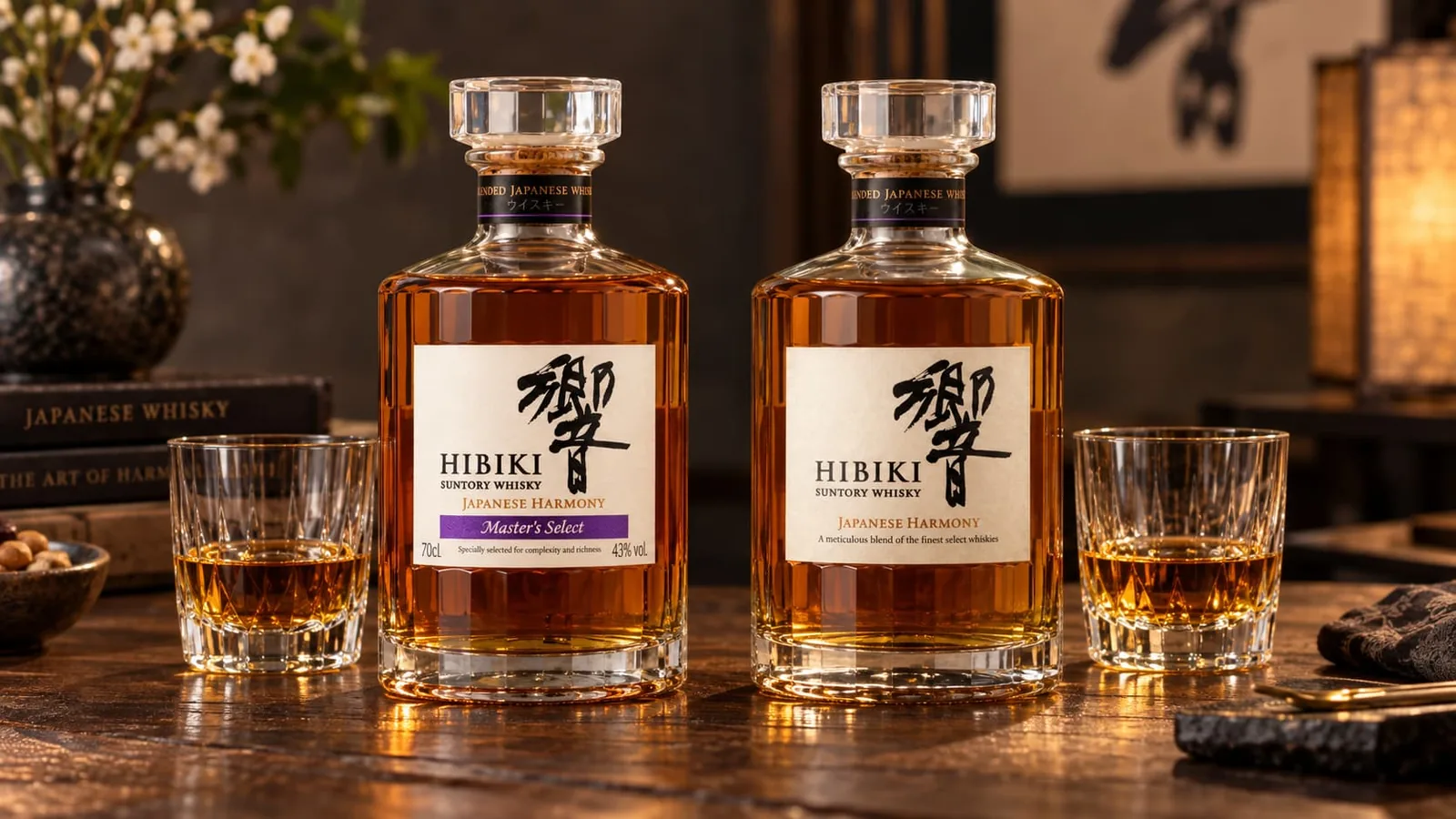
Hibiki Japanese Harmony is the sensible starting point if you're buying your first Hibiki. Master's Select is worth considering if you already like the range and want a little more sherry, oak and darker fruit. Whether that's worth the extra depends on the size of the gap, which on 1 October 2026 was about $45 at the cheapest shops, and on how much you like those flavours.
The names make this harder than it needs to be. Both say Japanese Harmony. Both come in the same faceted bottle. Master's Select sounds like the one you're supposed to buy once you know what you're doing.
There is a real difference, but the reviews don't agree that the dearer-sounding bottle is the better one. Here's what you can actually establish before spending the money.
The short comparison
| Japanese Harmony | Master's Select | |
|---|---|---|
| Type | Blended whisky from Suntory | Blended whisky from Suntory |
| Strength | 43% | 43% |
| Age statement | None | None |
| Where it started | Regular retail | Global travel retail, 2015 |
| Published flavours | Flowers, honey, citrus, white chocolate | Sherried fruit, dark chocolate, oak, spice |
| Best for | A first Hibiki, or lighter flavours | Harmony drinkers curious about a woodier style |
| Price on 1 October 2026 | $155.00 to $269.99 at 10 shops | $199.99 to $309.99 at 7 shops |
The flavour row sums up Suntory's descriptions and the independent reviews linked below. It's a guide to the difference, not a promise that everyone will find the same things in their glass. The prices are from our own checks of Australian retailers, for the regular 700ml bottles only, and the panel beside this piece shows them as they are today.
What the two bottles share
Both belong to Suntory's Hibiki family of blends, which brings together malt whisky from Yamazaki and Hakushu with grain whisky from Chita. Suntory describes Japanese Harmony as at least ten malt and grain whiskies aged in five types of cask, and coverage of Master's Select describes the same three distilleries and the same five cask types.
Neither bottle carries an age statement. Nothing on the Master's Select label tells you its youngest whisky is older, and the name gives you no grounds to treat it as a 12 year old in disguise. Both are bottled at 43%, so you're not paying for extra strength either.
The difference is in the balance of the blend and how it was sold. How many distilleries are in the backstory won't tell you which one you'll enjoy more.
What Master's Select changes
Master's Select entered global travel retail in October 2015, months after Harmony's own launch. It is a different blend, not regular Harmony in another box. Lotte Duty Free's description talks of "increased subtle sweet sherry notes", and the launch material reproduced by The Whiskyphiles mentions "hints of Yamazaki Sherry Cask" specifically.
That's enough to take the difference seriously. It still doesn't give us a recipe. Neither bottle comes with a published breakdown of ages, casks and proportions, so claims about exact percentages, or a guaranteed share of older whisky, need better evidence than a retailer repeating them.
The useful expectation is a shift towards sherried fruit and more noticeable wood. How that shift lands is where the argument starts.
What the tasting notes actually say
Suntory's notes for Japanese Harmony lead with rose and lychee, then honeyed sweetness, candied orange peel and white chocolate. There's wood in the description too, including a hint of mizunara, Japanese oak, on the finish. It isn't presented as a big, heavily sherried whisky.
The official notes for Master's Select move towards plum in syrup, orange marmalade and dark chocolate, with "a slight bitterness" and a finish of spice and wood. You can see the family resemblance in the fruit and sweetness, but the chocolate and the wood head somewhere darker.
Independent reviewers make the comparison more useful, because they don't all like the result.
- The Dramble called it "a fairly substantive step up from the standard Harmony bottling", with more body, raisins, dates and chocolate, and a woody finish with "last minute licks of bitter spice".
- The Whiskyphiles also preferred it, for "a touch more oak wood and a good chocolate component", though "occasionally it was overpowered slightly by the spiciness of the oak wood".
- Whisky Analysis went the other way. Its reviewer found that "some of the more delicate characteristics of Harmony are lost here, and too much oaky bitterness has been added", and recommended starting with standard Harmony.
The disagreement is the useful bit. If you like more wood and spice, Master's Select may feel like an improvement. If what you enjoy about Hibiki is the lighter, floral side, the same change may be a step backwards. A higher score from one reviewer can't settle that for you.
These are reviews of particular bottles, written in different years. Use them to decide whether the style sounds appealing, rather than expecting every note to turn up exactly as written.
Travel retail doesn't mean you need a plane ticket
Master's Select was made for airports, but Australian shops stock it too. On 1 October 2026 we found it in stock at seven of the retailers we track, and you can compare them on our Master's Select price page. Stock changes, so check the shop before you buy.
The airport connection doesn't make a price good on its own. Lotte Duty Free's Australian site listed the regular 700ml bottle at $189 the same day, about $11 under the cheapest shop we found, but you can only collect it when you fly out of the country. An overseas airport price is only useful once you've converted it to Australian dollars and allowed for bringing it home.
It's also worth separating where a bottle is sold from how scarce it is. Being sold through a particular channel tells you how it reached the shop. It doesn't tell you this is your last chance to get one.
Watch which Master's Select you're comparing
There are ordinary Master's Select bottles and decorative special editions, and that matters when one listing is far dearer than another.
The first was a limited edition launched with the travel retailer DFS in November 2015, a month after Master's Select itself arrived, in packaging decorated with cherry blossom, a royal carriage and flowing water, Edo-period symbols of good fortune. At the time Beam Suntory's travel retail marketing director, Michael Cockram, said it gave travellers "a product that cannot be found anywhere else at the moment", as reported by The Spirits Business. The artwork was the point.
That gap is still on the shelves. On 1 October 2026 the Master's Select Limited Edition was in stock at two shops we track, for $369.99 and $649.99, against $199.99 for the cheapest ordinary bottle.
If you like the design or you're buying a gift, paying for presentation can be a perfectly reasonable choice. Just check whether the seller is describing a different whisky or a different bottle. An elaborate box, an anniversary reference or the words "limited edition" don't establish a new blend on their own.
Compare the full product name, the bottle size and what's in the box. A price comparison between ordinary Harmony and a decorative Master's Select tells you very little about what the whisky itself costs.
How much extra is worth paying
Start with the best available price for each regular bottle. Comparing a cheap Master's Select against an expensive Harmony listing can make the upgrade look free, and comparing the other way round can exaggerate the premium. On 1 October 2026 the cheapest Harmony was $155.00 and the cheapest Master's Select $199.99, a gap of $44.99, or 29%.
Then ask what you want from the bottle. If you're new to Hibiki and mainly curious about its floral, honeyed style, regular Harmony is the lower-risk introduction. If you already enjoy Harmony but wish it had more oak and darker flavours, Master's Select has a clearer purpose.
A small premium is easy to justify for that curiosity. A large one deserves a bar pour or a sample first, if you can find one. There's no rule that a whisky costing nearly a third more will give you a third more enjoyment.
The same goes for how you drink it. If it's going over ice or into a highball, try a small serve that way before paying extra for differences in tasting notes that you may care less about once the drink is made. There's nothing wrong with mixing Hibiki; it just makes sense to pay for the drink you actually want.
Which one to buy
For a first bottle, start with Japanese Harmony at a competitive price. It's a good introduction to the lighter side of Hibiki, without paying a premium to explore a variation.
If you already know you like sherried fruit, firmer oak and a little bitter chocolate, Master's Select is worth a look. Check the gap and, ideally, try it before committing to a full bottle.
If you already own and enjoy Harmony, there's no need to replace it because Master's Select sounds more important. The reviewers who prefer the standard bottle have perfectly sensible reasons.
Buy for the flavour you want, at a price you've checked. The label has already done enough talking.
FAQ
Is Hibiki Master's Select older than Japanese Harmony?
Not that anyone can show. Neither bottle has an age statement, and Suntory hasn't published the ages in either blend. What's documented is a different balance, with more sherry cask and oak.
Is Master's Select only sold at airports?
No. It was launched for travel retail in 2015, but on 1 October 2026 seven of the Australian retailers we track had the regular 700ml bottle in stock, from $199.99.
Why are some Master's Select bottles so much dearer?
Some are decorative limited editions, sold for the packaging rather than a different blend. On 1 October 2026 the Limited Edition was $369.99 to $649.99, against $199.99 to $309.99 for the ordinary bottle.
Sources
- House of Suntory: Hibiki Japanese Harmony
- Lotte Duty Free: Hibiki Harmony Master's Select 700ml
- The Spirits Business: Beam Suntory GTR and DFS partner to explore world whiskies
- The Whiskyphiles: Hibiki Japanese Harmony Master's Select
- The Dramble: Hibiki Harmony Master's Select
- Whisky Analysis: Hibiki Harmony Master's Select